
DMU: 2020-21
Site: The Corah industrial complex, Leicester
Project: A co-operative response to the 4th Industrial Revolution.
Historically the effect of industrial revolutions is one of exploitation – of the environment and those working within it. The Fourth Industrial Revolution is already seeing significant upheavals in working relations and fundamental social and economic change: a reordering of society to one of complete surveillance, automation and the transformation of working and social life.
While often described as mechanisms for progress and positive change, for those who are subject to, and with little agency over, these changes, the consequences of capitalist exploitation are devastating. Starting with analysis of the ‘Dark Factories’ in Leicester - where workers earn less than the minimum wage in illegal and unsafe working conditions - we ask: ‘How can architecture address the Fourth Industrial Revolution in a way that puts social and environmental sustainability above profit?’
Located between the canal and the city centre, the historic Corah factory complex in the ex-industrial heart of Leicester, embodies the architectural history of successive industrial revolutions and working conditions through the ages.
How we can produce a co-operative architectural response that is symbiotic and mutually sustaining, designed for the benefit of the environment and of those who will be living and working within it?
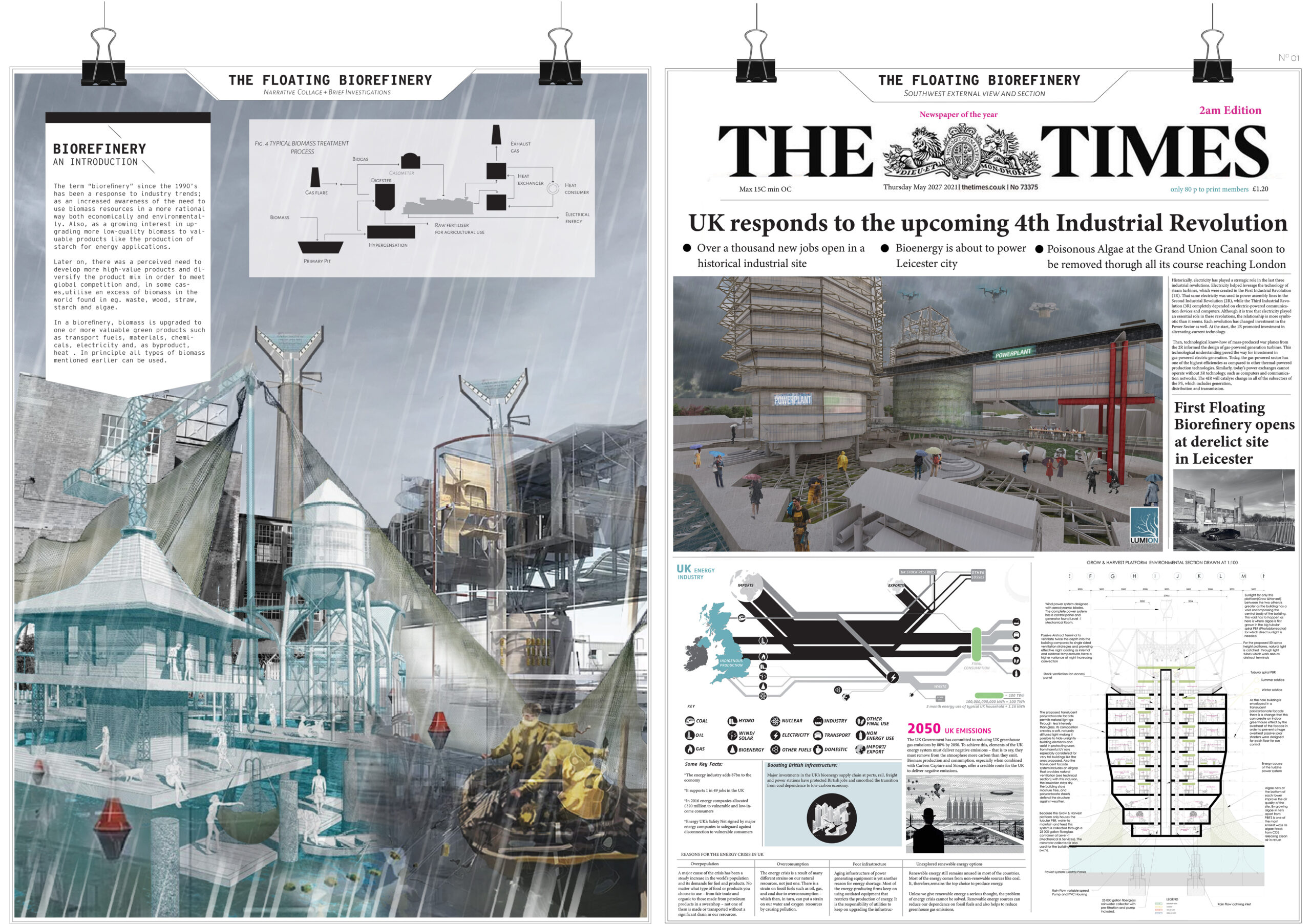
Illustrated is Domenica Friere's response 'The Floating Biorefinery' was nominated for the RIBA Bronze medal:
'The Floating Biorefinery is driven by the pressures of finding new sources of energy to supply the forthcoming demand of the next Industrial Revolution. The project envisions a new self-sustaining architectural apparatus inserted into the abandoned post-industrial site of Corah in Leicester. The proposed structures exist symbiotically with their environment and with the commitment to harvest Corah’s quickly replenishing biofuel: Algae. This is then upgraded into valuable green products such as transport fuels, materials, pharmaceuticals, electricity and heat.
30 years from now, initiated by this pioneering small-scale algae biorefinery unit, Corah would be transformed through a sustainable process of incremental urbanism and extended through a smart grid strategy. With Corah as a model, this could inspire other self-sustaining communities around the world to live symbiotically alongside natural elements such as growing algae at The Grand Union Canal.
For this to happen, the architect of the Fourth Industrial Revolution is no longer an individual but must operate as part of an entropic collective, employing empathy to create networks for innovation, and to develop a revolutionary architecture to solve global issues.'
40 Fairford House
Cotton Gardens Estate
Kennington Lane
London
SE11 4HW
tel. 0207 735 5000


